Welcome to The Writer's Challenge

I'm updating weekly-ish and whenever something exciting happens, so please come back often, browse the archived information,
and use the search feature to find information!
Learn more about my books at ShoshannaEvers.com
Showing posts with label writing class. Show all posts

Thursday, December 10, 2009

Research for Your Novel


Hello Fellow Writers!

Yesterday I started writing a historical romance that I'm targeting towards Harlequin's Historical Undone line. As I write, I'm not letting myself get bogged down in details (like what exactly would her wedding dress look like in 1820?). Details involve research, and that's for later, after the main story is down on paper. Otherwise I have a feeling it will never get written!

So how do you do research for your novel? I found an article online here at EzineArticles.com by John T. Jones, PhD.

How do you start writing a novel?
The first thing I do is decide the genre and the setting.
I suppose you saw some version of Back to the Future. Here the setting is changing not because of location, but because of time period. Flashing back or forward changes the appearance of the same location. The setting is new, isn’t it?
Genre is the type of novel you are writing. That could be a western, action, romance, detective, mystery, gothic, or what ever you decide to dream up.
Science fiction would be another genre.
Did you notice a possible change in the genre in one version of Back to the Future? The kid on the skateboard changed to a gun-totting westerner. Well, it was still science fiction.
The setting is where the action takes place. If the action is in the present, you will not have a great deal of research to do on the time period of the action. However, if the action takes place in 1850 or 130 B.C., you must do research on that time period as was done in Back to the Future.
Once you have decided where the action is to take place and in what time period, you can define your characters. Here are some things to consider:
Names:
Does the name of each character fit into the location and time period?
Don’t call your Viking raider, Joe.
Try Eric the Mad or some such.
Language:
What would the language be of your character?
If he lived in 1750 in London, what phrases would he use?
What would he sound like?
That will depend on his class won’t it?
A London cobbler would not sound the same as the Captain of the King’s Guard would he?
What about the King himself?
How would he sound? What vocabulary would he use?
Here is a Warning:
Don’t write a period novel if you are not willing to obtain the education and knowledge you will need to write it.
The key to good writing is to write about things you know and understand.
Of course, if you are writing science fiction, you can do anything you darn please as long as it “rings true” to science fiction readers.
That’s why the advice often given to writers is to read heavily in the genre in which they intend to write.
That’s one way to get an education, isn’t it?
Dress
If you met a man in Walgreen wearing a silver body-tight jumpsuit and having antenna sticking out of a gold helmet, you would think: That guy isn’t from here!
If your character walks into a Wild West bar in 1850 wearing a green suit, you will have some explaining to do. My guess would be that he is Irish and will be asking for a Guinness. Note: Guinness started in 1759 but I doubt that you would find it in the Wild West in 1850.
Dress must be consistent just as language is important. You need to know the local dress, not some stereotype dress you saw in a “B” movie.
Dress is also characteristic of vocation and class. A banker, a blacksmith, a millwright, etc., would all be differently dressed in the same location during the same time period.
Early settlers from Texas in Arizona could be told by their hats.
Other Factors:
If your character is a nurse, you must know something about how a nurse performed at her location and during her time period.
Don’t have that soldier shoot someone with a Winchester during the War of 1812. Oliver Winchester was born in 1810.
Each character needs a history. A person’s history at least in part determines his or her actions. You may never mention such a history in your novel, but you must know it.
Each character needs characteristics. You may never mention most of them but you must know them. These are the things that in combination make your character distinct from all other characters in the world. Take Superman for instance or Henry the Eighth.
The bottom line is that all things must be consistent and logical if you want your novel to fly.
If something is strange, you have some explaining to do.
How to do Research
The easiest way to do your research is by reading in your genre.
I don’t like reading most novels. Therefore I do research on the time and place.
I like to start with a map of the area. Then I like to read the history of the area even before the time period determined. I read history books, old magazine articles, Internet articles, etc. I like to visit the area and visit museums and historical societies. I like to talk to the people, especially the old timers that have significant tales to tell.
Go into book stores, yard sales, book sales, junk shops, antiques shops, and other places you can pick up magazines and books for a song. Look at the stuff they are selling in antique shops and ask about the history of unusual items. The way you do that is to say this: What is that thing?
In a way, it is much like being a newspaper reporter. I like to search old newspapers for interesting stories to see what other “reporters” have done.
Look in old encyclopedias, catalogs, and almanacs. You will be surprised what you can learn.
When I was writing Revenge on the Mogollon Rim, I decided to read one of Zane Grey’s novels, the settings of which was in the areas near my home in Arizona.
I knew something about Zane Grey because I was a guide and worked on exhibits for the local museum.
I expected to help in the rebuilding of his cabin that was destroyed in the Dude Fire. However, I moved from the area (Payson, AZ) before that task was started.
Anyway, I was reading his novel and came up on a phrase that didn’t seem right to me. It was a view his character saw from the Mogollon Rim. I didn’t think he had it right. I drove to the Rim and parked very near the place he described. Then I saw that Zane Grey had described the view perfectly. Mountains don’t move that fast.
It’s a good idea to know your subject, your location (setting), and your characters before you start writing the novel. Well, don't let that stop you. You can fill in the blanks later.
Just don’t let some bold character take over your book.
Writing, how to write, setting, characters, language, characteristics, history, time period, research
John T. Jones, Ph.D. (tjbooks@hotmail.com), a retired college professor and business executive, Former editor of an international engineering magazine. To learn more about Wealthy Affiliate University go to his info site. If you desire a flagpole to Fly Old Glory, go to the business site.
More info: http://www.InternetBusinessToolCenter.com
Business web site: http://www.AAAFlagpoles.com
This is all wonderful advice, but one thing bothers me a bit. Did you notice how he said that he doesn't like to read most novels? I can't even imagine not liking books, especially for a writer! Reading is such a huge part of my life. I love novels.

Yesterday's writing group was canceled due to inclement weather, but my romance novel loving friend Maureen said she would go with me on Saturday to the Hudson Valley Romance Writers of America monthly meeting.

Today I have a big day. I'll be going to a job interview for a nursing position that's every other weekend, which would be perfect for me since I could still stay home with my baby and write! Also, tonight is my 3 year wedding anniversary with my darling husband Jeff.

Wish me luck, and good luck to you too!
Yours Truly,
Shoshanna Evers

Wednesday, October 28, 2009

Writing a Synopsis


Hello Fellow Writers!

Yesterday I worked on my synopsis, getting it down to two single spaced pages, as Harlequin requires. Unfortunately, I don't think it's quite right. Or maybe it is. I don't know and I'm going crazy thinking about it.

I'm currently reading NY Times bestselling author Nina Bangs' book "My Wicked Vampire". I love vampires, so I'm having fun reading it.

Here is what former literary agent Vivian Beck has to say about writing a synopsis. The Vivian Beck Agency, while it no longer exists, has a lot of good writing tips on the website here.

Step 1: Start With A Hook. This should be a paragraph or two similar to the blurb on the back of a book. Mood and tone is important here, use special adjectives.
Step 2: Introduction of Characters. Introduce the main characters in your book. Tell their MOTIVATION, CONFLICT, and GOALS. Stay away from detailed physical descriptions unless this information is pertinent to your story.
Step 3: Construct the Body of Your Synopsis. Here, using paragraphs, write the high points of your story in chronological order. Keep these paragraphs tight, don't give every little detail. Remember, each scene should include, ACTION, REACTION, and a DECISION.
Example: Sam kisses Mary goodnight. (ACTION) He makes her forget she does not want to get involved in a relationship. (REACTION) He's dangerous to her hard-earned peace of mind. (DECISION)
Step 4: Use Three or Four Paragraphs to Write the CRISIS and RESOLUTION of Your Story. Keep this simple, but make sure you show your main characters' reactions. Don't keep the editor/agent guessing. Your synopsis must include the resolution to your story.
Step 5: Rewrite your synopsis until each sentence is polished to the point of perfection. Use strong adjectives and verbs, and always write in the present tense. Make every word count.

Today I have my last writing class. I'll be sad the class is ending but I think I got a lot out of it. I know my novel "The Movie Star's Very Personal Assistant" is better for it. The other women in the class and I are going to keep in touch about our writing and hopefully meet up as well. Since I had some dental work done today, I'm thinking about taking a day off from writing to veg out in front of a DVD on my laptop. We'll see. I usually end up tinkering with something, it's just how I roll.

G-d knows I won't have the luxury of a day off when November 1st rolls around (on Sunday!) and NaNoWriMo begins!

Wish me luck and good luck to you too!
Yours Truly,
Shoshanna Evers

Thursday, October 15, 2009

Query Letters


Hello Fellow Writers!

Yesterday I had my writing class, and it looks like I have some work to do on a chapter in "The Movie Star's Very Personal Assistant". I need to change some details to make it more believable. So I started working on that a bit. No work was done on "Snowed in With a Millionaire" but that will happen today.

I'm reading a wonderful Harlequin Presents book by Katherine Lang called "The Millionaire's Misbehaving Mistress" and I am enjoying it so much! I'm starting to wonder if maybe my stories might be better suited for Harlequin Presents than for Silhouette Desire.

Today I would like to look at how to write the perfect query letter to a literary agent.

From AgentQuery.com, there is an article that goes into detail about writing a query. Here is a small piece of that article:

A query letter is a single page cover letter, introducing you and your book. That’s it. Nothing more, nothing less. It’s not a resume. It’s not rambling saga of your life as an aspiring writer. It’s not a friendly, “Hey, what’s up, buddy. I’m the next John Grisham. Got the next best selling thriller for ya,” kind of letter. And for the love of god, it is NOT more than one-page. Trust us on this.

A query letter has three concise paragraphs: the hook, the mini-synopsis, and your writer’s biography. Don’t stray from this format. You won’t catch an agent’s attention by inventing a creative new query format. You’ll just alienate your chances of being taken seriously as a professional writer. A query letter is meant to elicit an invitation to send sample chapters or even the whole manuscript to the agent. It’s not meant to show off how cute and snazzy you can be by breaking formatting rules and going against the grain. Keep it simple. Stick to three paragraphs. The goal is to get the agent to read your book, not to blow you off because you screwed up the introduction.

Here is an example of an actual query letter, from pubrants.blogspot.com. This blog is written by a successful literary agent. She posted a query that got her attention (and then they sold the book). Ms. Nelson's comments are in blue, and the rest is the actual query.


Dear Ms. Nelson,

I’m a faithful reader of your blog. I admire your enthusiasm, your humor, and your candor. She reads my blog! Okay, I really shouldn’t be swayed by such flattery but hey, I’m human. Since you represent all subgenres of romance, I’d like you to consider Schemes of Love, my historical romance set in late Victorian England. The manuscript is complete at 100,000 words. Nice orientation to her novel.

Gigi’s marriage is doomed from the moment she decides that she must have Camden, by fair means or foul. How can I resist? Right off we know the fall our main heroine is going to take. Talk about flawed and therefore, immediately interesting. Camden, who has come to adore Gigi, discovers her deceit on the eve of their wedding. Shattered, he responds in kind, gives her a tender, unforgettable wedding night, then coldly leaves her in the morning, devastating her. Ah yes, two souls who have now done two wrongs. It’s a romance; I must know how they will make this right. Seriously though, this is such an intriguing set up and combined with the paragraph below, it’s something I’ve never seen before and folks, I read a lot of romance queries and sample pages. It’s hard to find something wholly original and fresh.

As the story opens, it is ten years later. Gigi has petitioned for divorce in order to remarry. Camden returns to England and sets the condition for her freedom: an heir. I’m sold. Didn’t even need to read more. She wants a divorce. He wants a child. Hum… sounds like an intense conflict to me. Despite the years and the sea of bad blood, the physical attraction between them remains as ferocious as ever. Big hint this work is going to be sensual and boy, is it—in very different ways. There’s a sex scene in the novel (and I can’t give it away) unlike anything I’ve ever read anywhere. That’s saying something. Though they each vow to make the act of procreation a cold, clinical one, the overwhelming pleasure of their marriage bed soon makes it apparent that the enterprise is fraught with emotional peril, for both of them. Oops. Two characters who think they don’t like each other but have great sex. What more could I want? Seriously, notice the wonderful cadence of Sherry’s language here: “Though they each vow to make the act of procreation a cold, clinical one, the overwhelming pleasure of their marriage bed soon makes it apparent that the enterprise is fraught with emotional peril, for both of them.” That’s some gorgeous writing and it’s only her query letter I’m reading. If you notice, the whole query is like that, and the novel doesn’t disappoint either.

In an atmosphere thick with mistrust, desire, and incipient hope, they are torn between the need to safeguard their hearts and the yearning to reach out across the chasm of ancient mistakes. May favorite kind of construct. As they rediscover the easy rapport they’d once shared, they must decide whether to let the bygones rule the future, or to love despite their painful past and forge a new life together. I don’t know about you but I’m totally rooting for them to let bygones be bygones.

Schemes of Love recently placed first in its category at the Merritt Contest, organized by San Antonio Romance Authors. Excellent. It has received recognition. Chris Keeslar at Dorchester has requested the full. And editor interest! This actually isn’t a big deal for me because it seems like editors request everything but hey, it doesn’t hurt. Another one of my manuscripts has won the Romantic Elements category of the 2005 On the Far Side contest, hosted by the Fantasy, Futuristic, and Paranormal Chapter of the RWA. Some other credentials and shows a little diversity from just the Historical stuff.

Thank you for your time. I hope very much to work with you and look forward to hearing from you. And she did, quite quickly. Big smile here.

Sherry Thomas
Well, there ya go. I worry about the fact that I have no writing credits - well, I do write this blog everyday - but that's about it. So that concerns me. I'll just have to hope that my stories speak for themselves.

Today I'm going to work on some revisions for "The Movie Star's Very Personal Assistant" and get some plotting done for "Snowed In With a Millionaire."

Wish me luck and good luck to you too!

Yours Truly,
Shoshanna Evers

Thursday, October 8, 2009

Writing for Children


Hello Fellow Writers!

Yesterday I actually worked on the plot of "Snowed in With a Millionaire", just like I said I would. I think the power outage that knocked out my internet helped - all I could do was use my laptop to write until the battery died! If it wasn't for that power outage I very well could have spent hours looking for the perfect sink for my bathroom renovation.

Right now I'm reading "Ruthless Awakening" by Sara Craven, a Harlequin Presents novel. So far I am really enjoying it.

In my writing class last night, Maureen, who has written a children's book, was told by our teacher that she should write a query letter and see about getting it published. I'm slightly jealous since I haven't heard any comments like that yet for "The Movie Star's Very Personal Assistant", but she's got a great story so I hope it sells.

And on that note, I wanted to share some information I found about writing for children. The suggestions regarding revision really hold true for any type of writing. From cbiclubhouse.com, "The Community for Success-Minded Children's Book Writers", here are five ways to make your children's book manuscript shine before you send it to a publisher.


Today I will be continuing my work on "Snowed in With a Millionaire". I have to get the plotting done before NaNoWriMo starts next month!!

Wish me luck, and good luck to you too!
Yours Truly,
Shoshanna Evers

Wednesday, October 7, 2009

Ray Bradbury Speaks About Writing

Hello Fellow Writers!

Yesterday, instead of writing, I ripped the sink out of my bathroom (ah, the joys of a DIY bathroom renovation). I did, however, review a couple of notes my writing teacher, Vinnie Daquino, made about my novel "The Movie Star's Very Personal Assistant." All in all it seems like the people in my class are enjoying my book, which makes me very happy - and slightly less afraid to send it out into the world. Just not yet.

Today I wanted to share with you writing advice from the great Ray Bradbury. He has published about 500 novels, short stories and poems, so he knows what he is talking about.


Usually I do love writing - it's why I do it so much. I especially love the feeling of creating something new - perhaps that's why I have a drawer filled with the first 30 to 50 pages of a novel, and then I let it go and start something new. At least I have two completed novels under my belt (even if one of them, a young adult horror novel entitled "Ambition" is truly awful).

And during the month of November, just 24 days from now, I will write "Snowed In With a Millionaire." And I will blog about it.

But for today... today I will work on the plot of "Snowed In" and try not to obsess to much about my bathroom renovations.

Wish me luck, and good luck to you too!

Yours Truly,
Shoshanna Evers

Monday, October 5, 2009

Writing Christian Romance

Hello Fellow Writers!

Sorry I'm putting this up so late today, I was having technical difficulties. I won't bore you with them but suffice to say I couldn't post a new blog till now. Grrr.

Yesterday I put my revisions for "The Movie Star's Very Personal Assistant" into the computer and emailed them to my Advanced Writing Class, who liked them. I didn't do any plotting for "Snowed in With a Millionaire". I know, I know, what is wrong with me? The good news is that I now have a real deadline - I need to have this outline finished by the end of October because I have to write the whole novel in the month of November! Yes, you heard me. I'll be participating in NaNoWriMo this year.

Now, you're probably wondering what a good Jewish girl like me is doing blogging about writing Christian Romance. But maybe you're interested in writing inspirational romance that's faith based. I like the idea since I consider myself very spiritual and even a bit religious (Jewish though of course) but my understanding is they really want you to be Christian to write for them. One of the interesting things about writing inspirational romance is they have extremely specific rules that must be followed. Here is what Steeple Hill requires, from eHarlequin.com:


Mission Statement
Steeple Hill’s fiction program features wholesome Christian entertainment that will help women to better guide themselves, their families and other women in their communities toward purposeful, faith-driven lives.
Length: 55,000–60,000 words
Executive Editor: Joan Marlow Golan
Senior Editor in charge of line: Melissa Endlich
Senior Editor: Tina James
Assistant Editor: Emily Rodmell
Editorial Assistant: Sarah McDaniel
Editorial office: New York
Heartwarming Inspirational Romance
The Love Inspired line is a series of contemporary, inspirational romances that feature Christian characters facing the many challenges of life and love in today's world.
Each story should have an emotional, satisfying and mature romance; however, the characters should not make love unless they are married. These are "sweet" romances. Any physical interactions (i.e., kissing, hugging) should emphasize emotional tenderness rather than sexual desire or sensuality. Please avoid any mention of nudity.
All stories should focus on one hero and heroine who meet as early in the book as possible. The hero and heroine should be on the page together in the first chapter—the first page is even better. By the end of the story the main characters should be in a committed relationship.
In addition, we are looking for opening chapters that are compelling and grab the reader’s attention from the first line of the story. Some ways to create effective openings are to employ dialogue, keep paragraphs short, or open with a dramatic situation. Ineffective openings tend to occur when there is little or no dialogue or the author focuses on background and setup (e.g., heroine is in a car/bus/train/plane, reviewing the reasons why she is returning to or leaving her hometown).
Drama, humor and even a touch of mystery all have a place in the series. Foul language, taking the Lord’s name in vain, euphemisms for curses (heck, darn, gosh) and scenes containing violent content do not. Any subplots should come directly from the main story. Secondary characters (children, family, friends, neighbors, fellow church members, etc.) can also help contribute to a substantial and gratifying story. Stories should be in the third person. Stories can have international settings, though the main characters should be North American.
An element of faith must be present in the books, and should be well-integrated into the plot. The conflict between the main characters should be an emotional one, arising naturally from the story. And the progression of the story must incorporate the faith journey of hero and heroine, whether struggling to accept faith or simply being active members of their church community. By the end of the story, hero and heroine must be both believers and members of a church community.
Because Steeple Hill sells to both CBA and ABA bookstores, we must adhere to CBA conventions. The stories may not include alcohol consumption by Christian characters, card playing, gambling or games of chance (including raffles), explicit scatological terms, hero and heroine remaining overnight together alone, Halloween celebrations, magic or the mention of intimate body parts. Lying is also problematic in the CBA market and characters who are Christian should avoid lying or deceiving others. Exceptions can be made but must be approved by an editor.
We are looking for authors writing from a Christian worldview and conveying their personal faith and ministry values in entertaining fiction that will touch the hearts of believers and seekers everywhere.


See, I'm not sure I'd be able to convey my "ministry values". Plus I love sexual tension in stories, and that's a big no-no here.


Yesterday DH and I saw the movie "Surrogates" with Bruce Willis. It was good - it kinda made me want a surrogate...

Today I will work on "Snowed In With A Millionaire". Wish me luck and good luck to you too!

Yours Truly,
Shoshanna Evers

Sunday, October 4, 2009

NaNoWriMo

Hello Fellow Writers!

Yesterday I (gasp!) didn't get a chance to update this blog! I felt terribly guilty about it, but DH and I took the baby up to visit family in the country for the afternoon. The day wasn't a complete wash, writing-wise. While my hubby as using the computer last night (effectively keeping me from working on my "Snowed in With a Millionaire" plot, I took my hardcopy of "The Movie Star's Very Personal Assistant" and made a few key revisions that I had gone over with my Advance Writing Workshop. We will be buying a new laptop soon.

Today I wanted to talk about NaNoWriMo - that's National Novel Writing Month. It's coming up, starting November 1st! The goal for the month is to write an entire first draft - 50,000 words by computer word count - in one month. This year, I'm going to do it! I'm very excited. There will be many other crazy people like me doing the exact same thing, so I'll have lots of support. One of the rules is you can outline and plot all you want ahead of time, but you can't actually start writing until November 1st. So since it's taking me forever to plot "Snowed in with a Millionaire", I will finish outlining and plotting this month, in October, and then start actual writing in November.

Here is some info about NaNoWriMo from their website, nanowrimo.org.

If I'm just writing 50,000 words of crap, why bother? Why not just write a real novel later, when I have more time?

There are three reasons.
1) If you don't do it now, you probably never will. Novel writing is mostly a "one day" event. As in "One day, I'd like to write a novel." Here's the truth: 99% of us, if left to our own devices, would never make the time to write a novel. It's just so far outside our normal lives that it constantly slips down to the bottom of our to-do lists. The structure of NaNoWriMo forces you to put away all those self-defeating worries and START. Once you have the first five chapters under your belt, the rest will come easily. Or painfully. But it will come. And you'll have friends to help you see it through to 50k.
2) Aiming low is the best way to succeed. With entry-level novel writing, shooting for the moon is the surest way to get nowhere. With high expectations, everything you write will sound cheesy and awkward. Once you start evaluating your story in terms of word count, you take that pressure off yourself. And you'll start surprising yourself with a great bit of dialogue here and a ingenious plot twist there. Characters will start doing things you never expected, taking the story places you'd never imagined. There will be much execrable prose, yes. But amidst the crap, there will be beauty. A lot of it.
3) Art for art's sake does wonderful things to you. It makes you laugh. It makes you cry. It makes you want to take naps and go places wearing funny pants. Doing something just for the hell of it is a wonderful antidote to all the chores and "must-dos" of daily life. Writing a novel in a month is both exhilarating and stupid, and we would all do well to invite a little more spontaneous stupidity into our lives.

Here's a video I found on Youtube about a girl doing NaNoWriMo. THIS GIRL IS NOT ME. I don't even know her name - but she seems to have a genuine excitement for NaNoWriMo that I find positively inspiring, so check it out.


Today I am going to put my revisions into the computer for "The Movie Star's Very Personal Assistant", but I'm not sure how much I'll get accomplished past that because we're going to visit family again today and to see a movie (Surrogates with Bruce Willis - I'll let you know how it is.)

Wish me luck and good luck to you too!

Yours truly,
Shoshanna Evers

Friday, October 2, 2009

Writing a Great Opening


Hello Fellow Writers!

Yesterday I got nothing done on my plotting fro "Snowed in With a Millionaire". I could give a million excuses (the upcoming full moon, PMS, fussy baby, etc) but what it boils down to is I just wasn't feeling it. Stupid, I know. I tried to write a short story to get my flow going but that ended up just being stale and boring. So I rented a romantic comedy ("Ghosts of Girlfriends Past" with Matthew McConaughey and Jennifer Garner. It hit the spot - it cheered me up.

I got some good feedback on Chapter 3 of "The Movie Star's Very Personal Assistant" from my writing class, so I want to work on that as well, but I have a feeling that is not going to happen just yet if I want to overcome my writer's block and just get going with "Snowed in With a Millionaire". By the way, I read somewhere that romance editors don't like actors, artists, or athletes as their heroes, so my book will probably never see the light of day, but whatever. At least I can get it in good shape.

I wanted to put some information I found in an article by Nina Munteanu about writing a great opening to a novel. You can read the whole thing at writing-novels.suite101.com.

Arouse, Delay, Reward

The writer arouses interest in the reader by providing enough detail to get the reader to ask questions. Now they want something. You tease them with the delay; that keeps them reading and turning the pages. It also gives them the chance to try to come up with the answers themselves. The reward comes in stages. Don’t answer all their questions at once. That’s what the book—the story—is for.


I had big plans for today but so far it has been all about running around - I took the baby to visit my hubby at work for lunch, and then I had a doctor's appointment, flu shot, etc so suddenly it is 5:30pm and I am just sitting down to write this blog, much less get started on my work.

I'm going to just bite the bullet and get to work, since tomorrow we're supposed to drive up to the country to visit family and I don't know if I'll be getting anything done at all.

Wish me luck and good luck to you too!

Yours Truly,
Shoshanna Evers


  • Avoid starting your story at the beginning: instead, start mid-way, when something is already happening.


  • Quell the urge to put a lot of information about setting, character and situation: get things in motion first, then fill in slowly here and there. Let the details unfold with the story.


  • Thursday, October 1, 2009

    Stephanie Meyer - How She Did It

    Hello Fellow Writers!

    Last night I had my Advanced Writing Workshop, which was fun. I sent Chapter 3 out to the teacher to review, and it looks like I need to tweak my opening scene for Chapter 1. But the big news is that I renamed my novel! Maureen, a woman in my writing class who reads as many romance novels as I do, suggested that "Marrying a Movie Star" isn't an appropriate title because they don't marry as part of the plot. She's right, of course. So now I have renamed it (drumroll please) "The Movie Star's Very Personal Assistant". Fun, right?

    I am a little concerned about my word count for "Movie Star", however. I am confused as to whether Silhouette is using computer word count or 250 x pages word count. Because if it's computer word count, then I am like 10K words short! I've been searching on the internet for the answer and I keep getting conflicting advice.

    Yesterday I worked on my plot for "Snowed in with a Millionaire", and I realized what I need to do today - I need to open up a new document and start plotting all over again from page 1. Of course, the past two weeks and 30 pages of plotting that I have already done will be in my head, but I think what's hindering me is it's all jumbled in my head. I need to start fresh.

    I wanted to share with you an interview with Stephanie Meyer, the author of the "Twilight" series. She discusses how she started writing and how she ended up getting published. I bet the ten agents that rejected her query are kicking themselves now!!


    I'm a huge fan of Stephanie Meyer, but I gotta say, I am also insanely jealous. What an unbelievable story she has!

    Today I am going to restart on a fresh document my plotting for "Snowed in with a Millionaire."

    Wish me luck, and good luck to you too!

    Yours Truly,
    Shoshanna Evers
    Wednesday, September 30, 2009

    Insider Secrets from Top Writers


    Hello Fellow Writers!

    Yesterday I did manage to plot out more of "Snowed in with a Millionaire". Well, technically, I reworked some of what I have in the hopes that it will help me through the sagging middle. The going is tough but I'm plowing through it. If I can't manage to get 40 pages of really tight plot written then there is no way the story will make a good romance novel. I'd rather learn that now than after writing the whole thing and realizing it doesn't work!

    Today I will review a book on writing that I pulled off my shelf, after not having read it in a while:
    "The 101 Habits of Highly Successful Novelists: Insider Secrets from Top Writers"
    by Andew McAleer.

    This book was really good. Now that I have it in front of me again, I want to reread it for the motivation it inspires. It covers everything - from the creative side of writing, to the discipline involved in actually getting things written, to the business side of getting an agent and getting published. The contributors are all well known, published authors who know what they are talking about.

    Here is a tidbit that I especially enjoyed, from Daphne du Maurier Awaed winning author Vicki Stiefel, of the critically aclaimed Tally Whyte suspense novels, including Body Parts, The Grief Shop, The Dead Stone, and The Bone Man:

    First-draft rule: Don't go back. I love to edit. Love it! So when I'm writing a first draft of a new novel, I never do it. What! Yup, I never go back and edit. Why? If I did, I'd end up with about twenty pages of really, really, really well-edited material. And that would be it. On a first draft, I push forward. Period. Gee, but I'd love to go back and just tweak that one small section. Nope, not allowed. I push forward. Golly, if only I could smooth out those pages. I know they'd be better. Probably right, but no way, not now. Gosh, it would be great if I could have these words in the "real" Portuguese right now, I'll begin that research and... Forbidden. Don't do it. Just jot some quick notes and move on. Move forward. Always forward. Relentlessly forward. And that's how I write some 400-plus manuscript pages for a novel.

    Side roads are great, if you're driving a car or taking a hike. For me, they're crummy when writing a novel. So I write on, and write on, and write on. And suddenly, I'm there. Whew. And when I've finally made it to the finish line, I smile. Because that's when I pull out my pen, and I edit, edit, edit the bahoosie out of the manuscript. That's when I do thorough and important research. That's when I check spelling, continuity, and a million other things. But not before then. Because if I did, I'd never have finished book one.

    Rereading that section made me wonder if this is what is paralyzing me with "Snowed in with a Millionaire". I too love to edit, and I have a hard time shutting off my "internal editor". Then again, I can always put this theory to test once I have my plot outline finished. I really like what this author has to say because I love the idea of just writing, writing writing nonstop. If only it were so easy in practice as in theory!

    Today I am going to work more on my plot for "Snowed in with a Millionaire". Seriously, the fact that last week I made my daily goal to write out the whole plot in one day is laughable. This is taking longer than I had realized it would!

    Tonight I am going to my Advanced Writing Workshop, which I am looking forward to. The feedback I've received for "Marrying a Movie Star" has been very helpful so far, resulting in revisions that have strengthened the book.

    Wish me luck and good luck to you too!

    Yours Truly,
    Shoshanna Evers

    Sunday, September 27, 2009

    Writer's Block

    Hello Fellow Writers!

    Yesterday I planned on working on my plot for "Snowed in With a Millionaire". Instead, when I had a nice 3 hour chunk of time to write, I took a nap. I feel like I'm getting a cold so I felt the time would be better used for sleep. However, I went to bed that night feeling guilty - like maybe the real reason I didn't work on my novel at all was because I am suffering from a slight case of writer's block.

    I left off my writing at a place where I was stuck, and the thought of going back to that stuck, difficult place doesn't sound like fun. This is one of the reasons why I have numerous "half novels" - I'll get maybe 50 pages in or so and then give up and start a new one. My goal with "Snowed in With a Millionaire" is to ensure that I complete it by writing a very detailed, very long plot outline to help me through that time.

    Today I got a good piece of advice from one of the women in my writing class about "Marrying a Movie Star". She felt that one of the scenes seemed contrived and suggested I rework it - and now that she mentions it, I realize she's right. So I will work on that today as well as try to get my writer's block unblocked for "Snowed in With a Millionaire."

    Here, Bob Moresco, the Oscar winning co-writer for the film 'Crash', discusses writers block.


    He says it all - basically, just write through it. Don't worry about creating a masterpiece. Just write.

    Wish me luck and good luck to you too!

    Yours Truly,
    Shoshanna Evers

    Friday, September 25, 2009

    "First Draft in 30 Days"


    Hello Fellow Writers!

    Yesterday my goal was to take the love scenes in my romance novel "Marrying a Movie Star" to the next level, since I've recognized that my book is less Harlequin Romance and more Silhouette Desire...

    Perhaps it's because I've been living with my Hero and Heroine for so long, so I know them as well as I know myself - but it wasn't difficult to add a couple of romantic love scenes and an extra kiss in the places where I knew the characters wanted to be with each other. They had previously been kept from consummating their passion by the fact that I was nervous about my father reading the book!

    So I got a lot done yesterday. I also emailed out the first chapter to my book to my writing teacher, and so far the response has been quite positive. Yay!

    I could have gotten even more done and worked more on "Snowed in with a Millionaire", but all work and no play makes Jack a dull boy, so I stayed up late watching "The Biggest Loser" on Hulu.com. I was amazed that they could lose like 25 lbs in a week. Seriously.

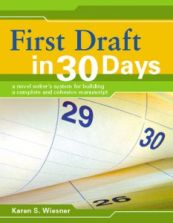
    I pulled another book off of my shelf to review for you, "First Draft in 30 Days" by Karen S. Weisner. Titles like that hook me every single time. I love the idea of writing a book in a month. It hasn't happened yet, but I still love the idea.

    Really what the book guides you to do is to create a very detailed outline, similar to the 40 page plot synopsis I've been writing for my work in progress based on 'The Marshall Plan for Novel Writing" by Evan Marshall. Weisner has written over 20 books, so her method must work for her. Unfortunately, the book is a bit dry. My main problem with it is I don't jump up and down with inspiration as I read it. On the other hand, another book that promotes writing a first draft in 30 days, "No Plot! No Problem" by Chris Baty, the founder of National Novel Writing Month, does make me get all excited and ready to write. So there you have it. By the way, NaNoWriMo is coming up in November and I'm seriously considering joining in on the fun.

    Left brain thinkers might like "First Draft in 30 Days" more than I did. Weisner does have a lot of good information and suggestions, however - including letting your outline sit for a while before you go back and look at it. I remember Stephen King said in his book "On Writing" that he did the same thing.

    Today my goal is to work on my plot for "Snowed in with a Millionaire".

    Wish me luck and good luck to you too!
    Yours Truly,
    Shoshanna Evers

    Thursday, September 24, 2009

    Taking a Writing Class


    Hello Fellow Writers!

    Last night I went to the first night of my Advanced Writing Workshop. That's a pic of the teacher, Vincent Dacquino. And yes, he's a published author - or I wouldn't be taking the class, honestly. No sense in the blind leading the blind! He wrote a children's fiction novel, "Kiss the Candy Days Good-bye", a Dell/Yearling paperback, an adult biography called "Sybil Ludington: The Call to Arms", and then a kid's version of that book for classrooms. Vinnie also has a book called "Hauntings of the Hudson River Valley: An Investigative Journey".

    One thing I'm totally psyched about is the class is just three other women, me, and the teacher. And get this - one of the women, Maureen, loves romance novels too! I practically squealed with excitement when I pulled the Silhouette Desire book that I'm reading out of my bag and she pulled not one, but two Harlequin Presents books out of hers! It will be much easier for me to put my novel "Marrying a Movie Star" out there knowing that there is at least one person in the class who reads romance as much as I do. The other women, Patricia and Jennifer, are writing non-fiction I believe, so that should be interesting. I think it's a good sign that Patricia took the class before with Vinnie and liked it enough to take it again. Sounds promising...

    Yesterday was a busy day, and I didn't get to sit down to write until about 9:45pm. I came thisclose to saying forget it, I'll write tomorrow, but if I do that then my work in progress, "Snowed in with a Millionaire", will never get done. Vinnie says: Writers write, talkers talk. Amen.

    Today my goal is to take my novel "Marrying a Movie Star" and find the perfect place for a romantic love scene. I was originally planning on making it a "tender" romance, with no sex, but now I'm feeling that it wouldn't be fair to my hero and heroine to deny them the physical relationship they crave! Who am I to tell them no?

    I also want to read a bit more of the Silhoutte Desire book I just picked up, "In the Tycoon's Debt" by Emily McKay. I love me some inspiration :)

    Wish me luck, and good luck to you too!
    Yours Truly,
    Shoshanna Evers

    Wednesday, September 23, 2009

    The Secret Formula of Most Romance Novels


    Hello Fellow Writers!

    Yesterday I worked on my plot for my romance novel, tentatively called "Snowed in with a Millionaire" (or maybe it will become "Snowed in with the Tycoon"). Usually I get my most work done when dear hubby returns from work so he can take the baby off my hands, but last night we watched a documentary online together, so there went two hours of valuable writing time. I don't know why I did that to myself - especially for a documentary I've already seen!

    Today I will get as much done on the plot as I can - though it will be a busy day, with a doctor's appointment an hour's drive away for the baby, and then tonight (drum roll please).... I start my Advanced Writing Workshop! I'm very excited. The purpose of the class, from what I hear, is to learn how to revise your fiction to make it better. Everyone is supposed to bring a work in progress. I will be bringing my romance novel "Marrying a Movie Star". My husband has been reading it since Sunday and he says "it's like a book from the book store". Here's hoping he's right, and I'm not going to seriously embarrass myself in this class.

    I've already decided that the category line I was planning to submit "Marrying a Movie Star" to (Harlequin Romance) isn't the right one - while my characters don't have sex, they have very explicit kissing and emotions - so I think if I take that to the next level and add in some romantic love scenes I can submit it to Silhouette Desire instead. (UPDATE: Marrying a Movie Star got a rewrite, sold to Ellora's Cave Publishing, and became Hollywood Spank!) (Another UPDATE 2/10/2014: Three years after selling Hollywood Spank to Ellora's Cave, I got the rights reverted back to me, and I self-published the book with fresh edits, a new cover, and a much lower price! I also put it in print using Createspace! You can see how it looks now here.)

    Actually, I really want to submit it to a literary agent first.

    I've been looking at a book I read awhile back, called "You Can Write a Romance" by Rita Clay Estrada and Rita Gallagher. The text is interspersed with fun quotes from published authors, like this gem:

    Never give the reader the chance to ask why your character didn't take the logical action. Either explain before hand or at the time of the incident why there were no other choices. That's called "pointing to the hole."
    - romance author Chelly Kitzmiller


    The authors also point out that most romance novels are a twist on a simple plot. They say it's not a formula, it's a guide, but really, what do you call this?

    • Boy meets girl.
    • Girl has a secret.
    • Girl keeps secret from boy as they fall in love.
    • Boy finds out and they part in anger.
    • Girl loses all.
    • Boy returns, repentant, to declare what they both knew all along. He loves her.
    • Girl is now strong enough to turn him down or take him back (as an equal partner).

    Although I did just read a wonderful romance novel by Sabrina Jeffries called "The Pirate Lord" where a woman was kidnapped by a pirate and taken to his secret island - that set up a really fun historical romance, no secrets necessary. So there are definitely exceptions to the rule.

    Now, back to writing. I'll let you know how the writing workshop went (it's a five week class) tomorrow. But before I go, one more fun quote from "You Can Write a Romance":

    Writing is an action verb. Do it, don't just talk about it.
    -romance author Maria Ferrarella

    Wish me luck, and good luck to you too!
    Yours Truly,
    Shoshanna Evers

    UPDATE!! For those who have stumbled upon this old post, I want to share the good news. Yes, I have a literary agent now (see how it happened here), and she got me a 6 book contract with Simon & Schuster Pocket Star! Please visit my website at ShoshannaEvers.com to learn more about The Enslaved Trilogy, out now!